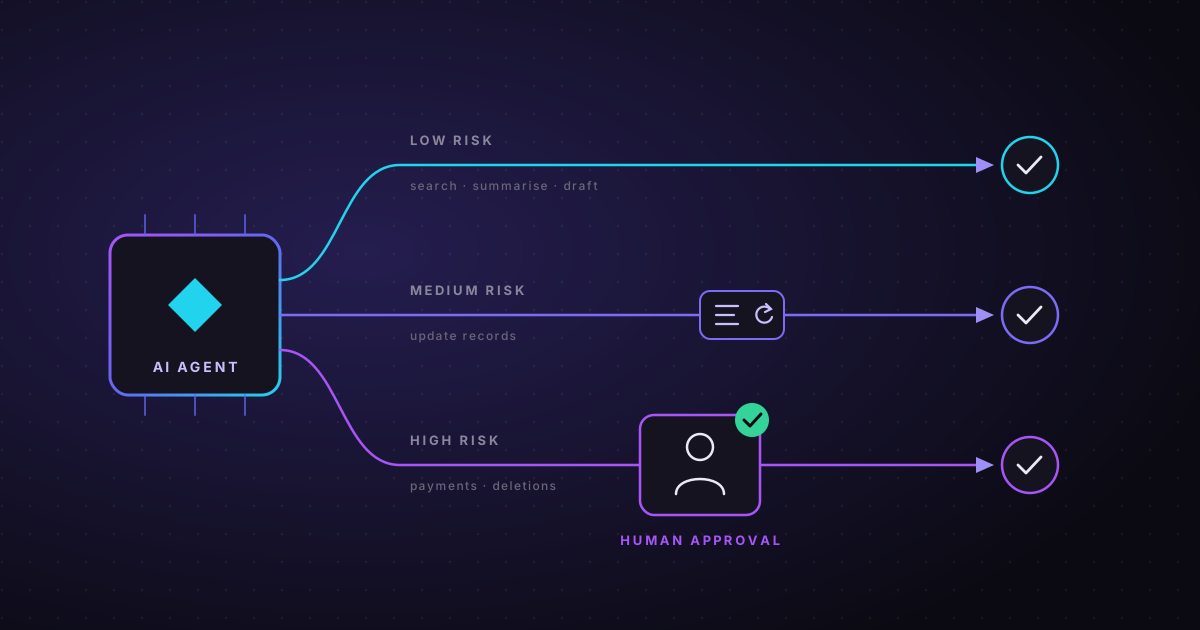
AI agents — systems that plan steps, call tools and act on the results — can take a lot of repetitive work off a team's plate. But an agent that can send emails, update records or move money also needs clear limits.
The question isn't whether to keep people involved. It's where.
Sort actions by risk
Start by listing every action the agent can take and asking what happens if it gets one wrong.
| Risk | Examples | Approach |
|---|---|---|
| Low | Searching, summarising, drafting | Let the agent act freely |
| Medium | Updating internal records | Act, but log and allow undo |
| High | Sending to customers, payments, deletions | Require human approval |
This keeps people focused on the decisions that matter instead of approving every small step.
Make approvals easy to review
An approval step only helps if the reviewer can understand what they're approving. Show:
- what the agent intends to do, in plain language;
- the information it based that decision on;
- exactly what will change, ideally as a before/after.
If reviewing takes longer than doing the task by hand, people will either stop using the agent or start approving without reading.
Give agents narrow tools
Broad tools ("run any database query") are hard to make safe. Narrow tools ("look up an order by ID", "add a note to a ticket") limit what can go wrong and make the agent's behaviour easier to test.
Keep a record
Every step an agent takes — the tool it called, the input, the result — should be logged. That record is how you debug failures, answer "why did it do that?", and build the confidence to automate more over time.
Expand autonomy gradually
Begin with the agent drafting and a person approving. As the logs show it making good decisions consistently, move specific actions to lower-risk tiers. Autonomy should be earned with evidence, not assumed on day one.