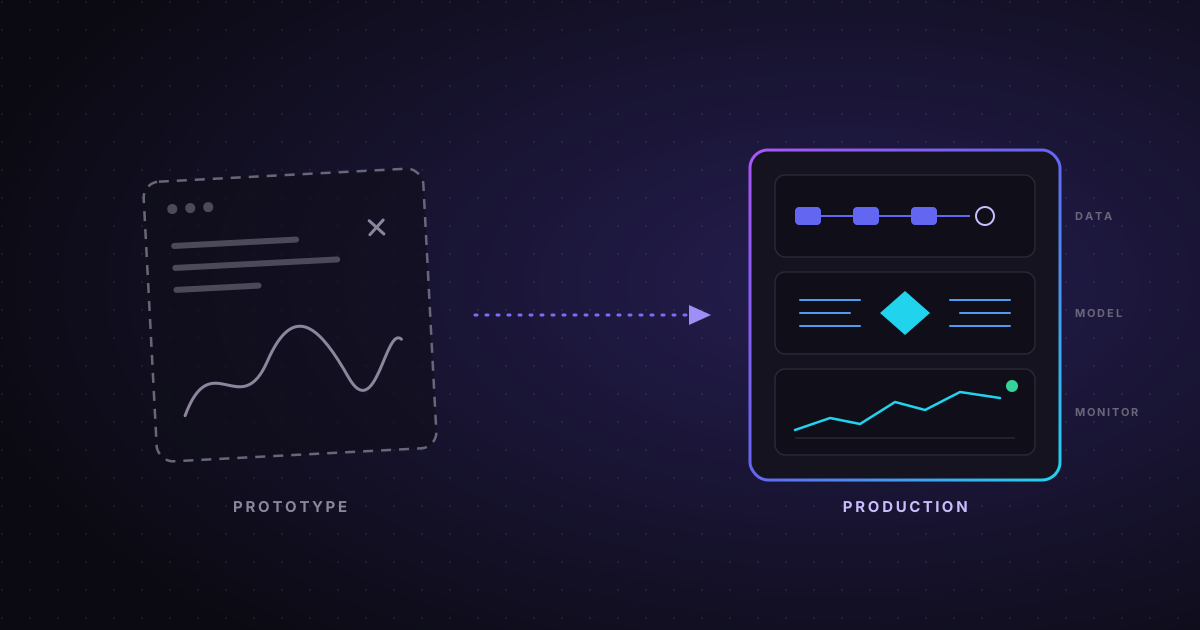
Most AI projects begin with a promising prototype. Moving from there to something customers rely on every day is a different kind of work. Here are the five changes we plan for from the start.
1. "It works" becomes "how well does it work?"
A prototype is judged by a handful of good examples. A product needs a repeatable evaluation: a fixed set of test cases, clear metrics, and a score you can compare from one version to the next. Without it, every change is a guess.
2. Data stops being a file and becomes a pipeline
Prototype data is usually a one-off export. In production, data arrives continuously, in changing formats, sometimes incomplete. Ingestion, validation and versioning need to be automated so the model always sees what you expect.
3. Latency and cost start to matter
A few seconds per request is fine in a demo. For real users it may not be — and the cost per request multiplies with traffic. Caching, smaller models for simpler tasks, and batching where possible all help keep the product fast and affordable.
4. Failures need a plan
Models will sometimes be wrong, slow or unavailable. Decide in advance what users see when that happens: a fallback answer, a retry, or a hand-off to a person. Graceful failure is part of the design, not an afterthought.
5. You need to see what's happening
Once the system is live, monitoring is how you find problems before users report them. Track inputs, outputs, errors and response times, and watch for drift — the gradual change in incoming data that slowly erodes accuracy.
None of these steps are glamorous, but they're what turn an impressive demo into software people can depend on. If you're planning that journey, we'd be glad to help.