"AI" covers everything from the spam filter in your inbox to science-fiction robots. To make sense of it, people usually sort AI in two ways: by how capable it is, and by how it works. This post explains both, in plain language.
Type 1: by capability
This is the grouping you'll hear most often. It asks one question: how broad is the AI's intelligence?
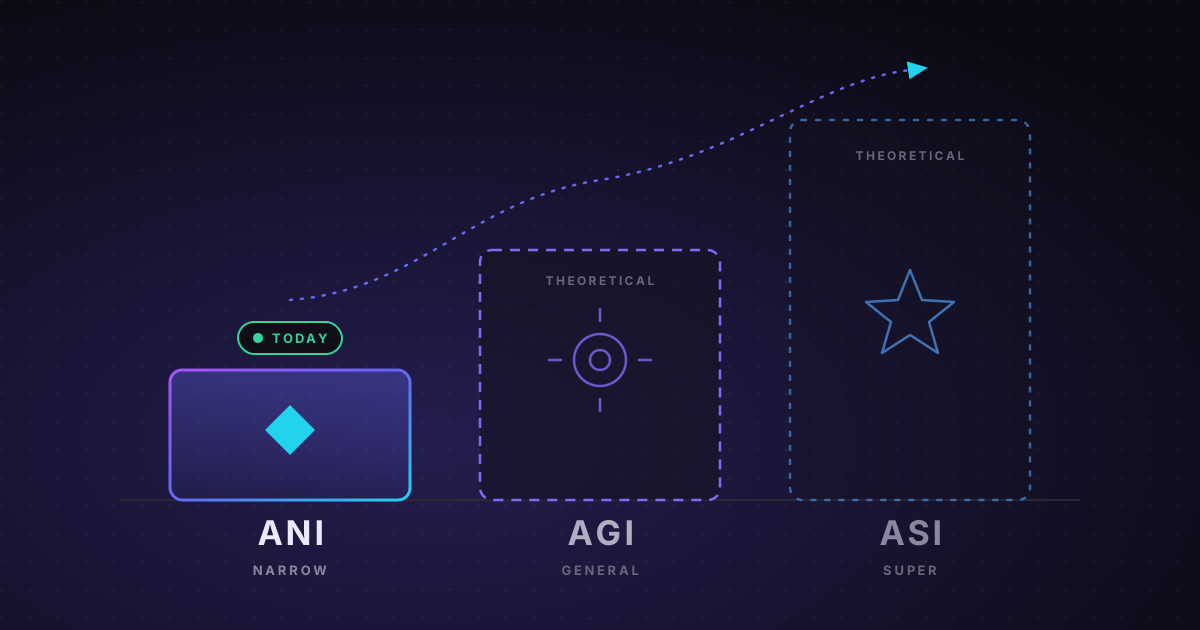
| Type | Full name | In one line | Exists today? |
|---|---|---|---|
| ANI | Artificial Narrow Intelligence | Very good at specific tasks | Yes: all current AI |
| AGI | Artificial General Intelligence | Matches people across almost any task | No: a research goal |
| ASI | Artificial Super Intelligence | Goes beyond the best people at everything | No: theoretical |
ANI: narrow AI
Narrow AI (sometimes called "weak AI") is built for a specific task or set of tasks. It can be extremely good at that job, often better than a person, but it can't step outside it.
Examples are everywhere:
- recommendations on YouTube, Netflix and online shops;
- face unlock on your phone;
- voice assistants and translation apps;
- fraud detection at your bank;
- driver-assistance features in cars;
- chat assistants such as ChatGPT, Claude and Gemini.
Every AI system in use today is narrow AI. Even the most impressive ones work within limits set by their training and design.
AGI: general AI
Artificial General Intelligence (or "strong AI") describes a system that could learn and perform almost any intellectual task a person can. It would understand new situations, reason across different subjects and pick up new skills without being specially built for each one.
AGI doesn't exist yet. Some researchers argue the latest models show early signs of generality, while others think true AGI is decades away or needs entirely new ideas. There's no agreed timeline, or even a single agreed definition.
ASI: super AI
Artificial Super Intelligence is a hypothetical AI that would outperform the best human minds in every field: science, creativity, strategy and social understanding.
ASI is purely theoretical today. It appears mostly in long-term research and in discussions about AI safety: if a system were ever far more capable than people, how would we make sure it stays aligned with human goals?
Is generative AI the same as AGI?
No, and this is one of the most common mix-ups, partly because both get shortened to "GAI".
- Generative AI (GenAI) is AI that creates content: text, images, code, audio or video. ChatGPT, Claude, Gemini and image generators like Midjourney are all generative AI.
- AGI is the idea of human-level intelligence across all tasks.
Generative AI can feel general because it handles so many topics. But it's still narrow AI: it predicts and produces content based on patterns in its training data, and it has clear limits, such as stating wrong facts with confidence. It's a powerful kind of ANI, not AGI.
Type 2: by how the AI works
A second grouping looks at how an AI system thinks and remembers. It has four stages.
1. Reactive machines
The simplest kind. A reactive machine responds to what's in front of it right now, with no memory of the past.
Example: IBM's Deep Blue, the chess computer that beat world champion Garry Kasparov in 1997. It analysed the board in front of it but didn't learn from earlier games during play.
2. Limited memory
These systems use past data, either from training or from recent events, to make better decisions. Almost all modern AI is in this group.
Examples: self-driving systems that track nearby cars over the last few seconds; chat assistants that use the earlier messages in a conversation; recommendation engines that learn from your history.
3. Theory of mind
A future stage where AI would genuinely understand that people have their own thoughts, feelings and intentions, and adjust its behaviour accordingly. Today's systems can recognise emotions in text or faces, but that's pattern-matching, not real understanding. This stage is still a research area.
4. Self-aware AI
The final, hypothetical stage: AI with its own consciousness and sense of self. Nothing like this exists, and scientists don't yet agree on how consciousness could even be measured in a machine.
How the two groupings fit together
| By how it works | By capability | Status |
|---|---|---|
| Reactive machines | ANI | Exists |
| Limited memory | ANI | Exists: most AI today |
| Theory of mind | Would be a step towards AGI | Research |
| Self-aware | AGI / ASI territory | Hypothetical |
What this means for your business
The AI you can use today is narrow, and that's good news. Narrow AI is practical, measurable and ready to deploy. It can answer customer questions, read documents, spot defects on a production line, forecast demand or automate repetitive work.
The key is picking a clear, specific problem and building the right system around it. That's exactly where narrow AI shines and where we spend our time. If you have a task in mind, let's talk about it.